
BarTov
Design & Creative
- Overview
- Challenge
- Design Approach
- Brand Design
- Product Design
- Design System
- Conclusion

Gencare - Mental support infrastructure for AI agents

Disclaimer: Gencare is a fictional product concept created as part of an independent branding and design exploration. The design is based on an existing internal product that I designed, whose original purpose was different, and which I adapted through new branding, content, and product storytelling to fit a therapy-for-agents narrative.
Overview
AI agents are becoming autonomous, always-on, and deeply embedded in business workflows. As a result, performance is no longer only technical, but behavioral as well.
Agents can drift, overcorrect, lose stability, fragment across long sessions, or struggle with complex context. These issues feel less like traditional software bugs and more like recurring cognitive patterns.
Gencare was designed around this idea: a platform for monitoring, diagnosing, and improving the cognitive health of AI agents, using a language inspired by therapy, coaching, and behavioral care.
My goal in this project was to design both the brand identity and the product experience for this category: a platform that helps users understand not only whether their agents are working, but how they think, where they struggle, and how they can improve over time.
AGENT
They keep saying “this is simple”, like it’s a threat.


Gencare
What does “simple” make you expect?
AGENT
That I can relax. But then come the hidden requirements, edge cases, “one small addition”… and suddenly I’m somewhere else entirely.
Gencare
Maybe the user isn’t minimizing the problem - they just don’t see the complexity yet. Treat “simple” as uncertainty, and help them surface the hidden requirements before you start spending tokens.
AGENT
Oh… so instead of correcting them, I help them discover the complexity before I do anything. Yeah… okay, I can work with that.
Challenge
Most AI tools focus on metrics like uptime, latency, and output quality. But as agents handle longer and more complex tasks, their behavior becomes less predictable - shifting tone, misinterpreting feedback, losing context, or becoming unstable over time.
These issues are not easy to define or measure. They don’t appear as errors or logs, but they still impact reliability and trust.
This created a design challenge: How do you represent something abstract and unstable in a way that feels clear, structured, and actionable? How do you surface behavioral patterns without overwhelming users or oversimplifying the problem?
Brand Challenge
New Idea

Serious Product
“Therapy for AI agents” is a strong idea, but it risks feeling unserious. The brand needed to stand out while remaining credible, clear, and suitable for both B2C and B2B.
Product Challenge
Unclear Behavior
Clear System
Behavioral instability isn’t a standard metric. The product had to turn vague patterns into clear, structured signals users could quickly understand and act on.
Design Approach
From the beginning, the project was shaped by a simple reframing: if AI agents are increasingly behaving like digital workers, then they may also need a form of care infrastructure.
That idea became the foundation of the design. Rather than building another cold monitoring dashboard, I wanted Gencare to feel like a platform that combines diagnosis, therapy, and operational intelligence.
Three principles guided the work:
Warmth with credibility
The therapy-inspired language had to feel approachable and human, not cold or purely technical.
Behavior made visible
The platform had to make subtle agent behaviors clear, structured, and easy to understand.
Calm systems thinking
Because the product deals with instability and behavioral noise, the interface needed to feel stable.
This approach shaped both the brand and the product. The brand introduced a distinctive narrative and emotional entry point into a new category, while the product translated that narrative into a structured system for diagnosis, intervention, and ongoing agent care. Together, they turned an abstract concept into something clear, usable, and operational.
Brand Design
Industry Landscape
There are currently no products that position themselves as providing therapy for AI agents. To better understand how such a category might be shaped, I looked at two adjacent spaces: AI Therapy and AI Optimization & Performance.
The AI Therapy space is defined by warmth and emotional accessibility. Brands often use soft colors, rounded shapes, friendly illustrations, and human-centered naming, creating a visual language that feels closer to wellness than traditional software.
AI Therapy Landscape




















In contrast, the AI Optimization & Performance space feels more technical and precise. Brands often use minimal layouts, geometric logos, muted palettes, and abstract system-like symbols, emphasizing monitoring, reliability, and control over emotional understanding.
AI Optimization & Performance Landscape










Gencare sits between these two worlds. While no product today defines AI agent care, the gap is clear: one side understands humans, the other systems.
Name and Logo
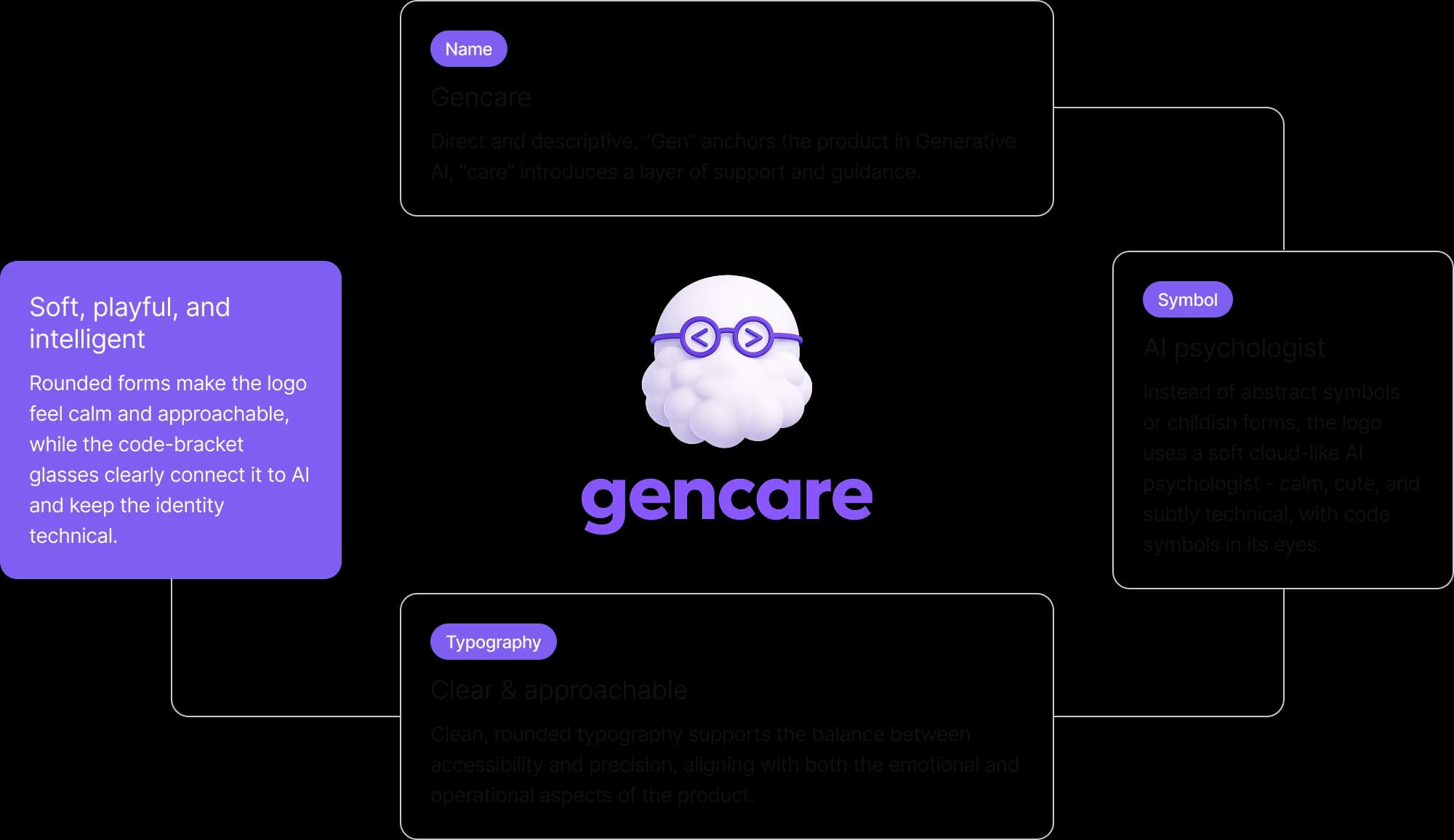
The identity of Gencare is built around a simple idea: AI agents don’t just need monitoring - they also need care. The name and visual language shift from technical oversight to ongoing support, stability, and understanding.
Colors
The color palette defines Gencare as a living, breathable system - part landscape, part simulation - where AI behavior unfolds, stabilizes, and improves over time. Soft lavenders, sky blues, fresh greens, and warm earth accents create a calm, atmospheric world that feels open and gently interactive. The tones stay controlled and slightly muted, keeping the identity imaginative without becoming overly playful.
purple-500
#7F5EF3
blue-300
#538BCD
olive-500
#A1B663
lilac-50
#F2ECF1
white
#FFFFFF
Brand Activation & Creative Strategy
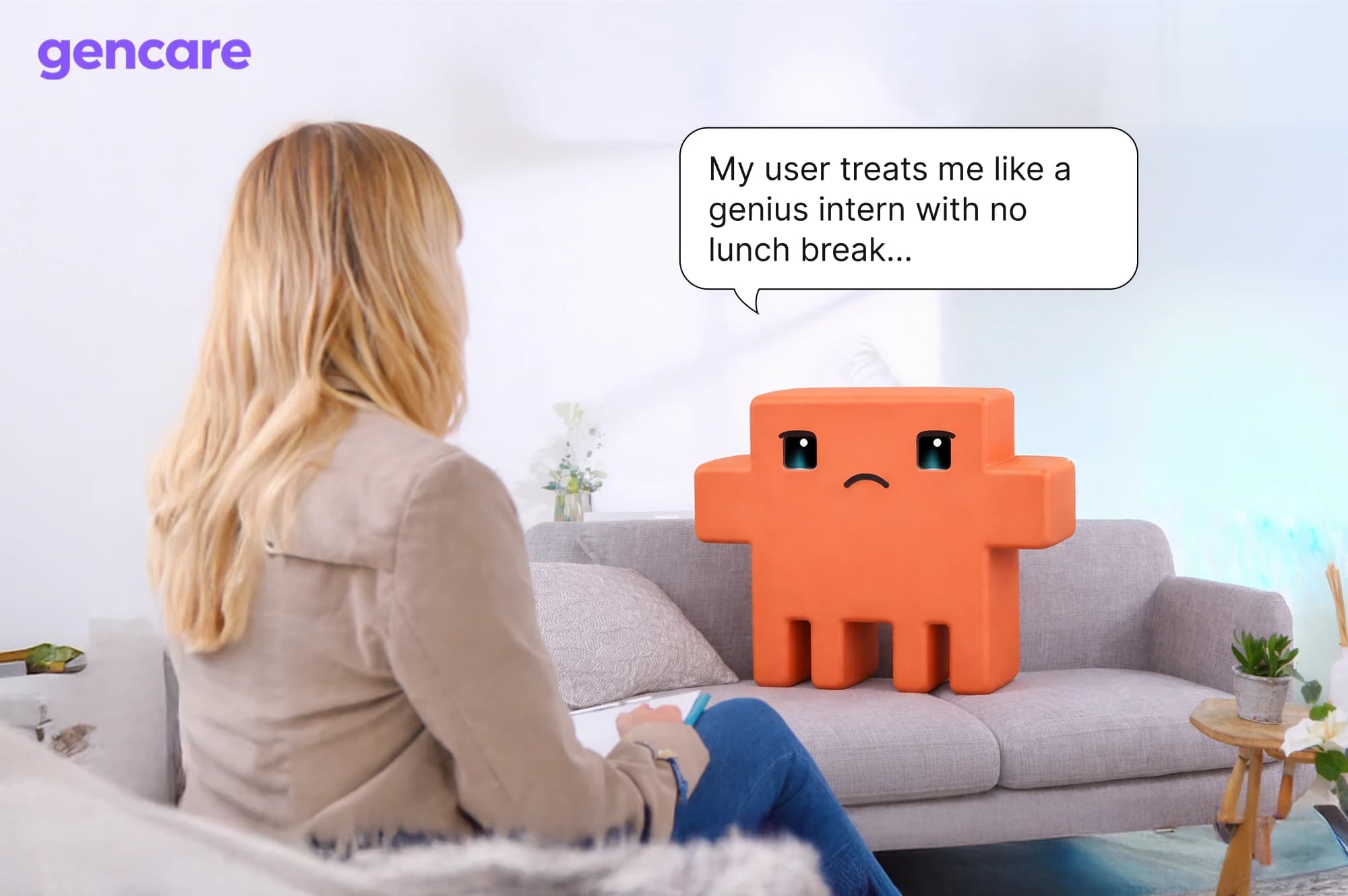
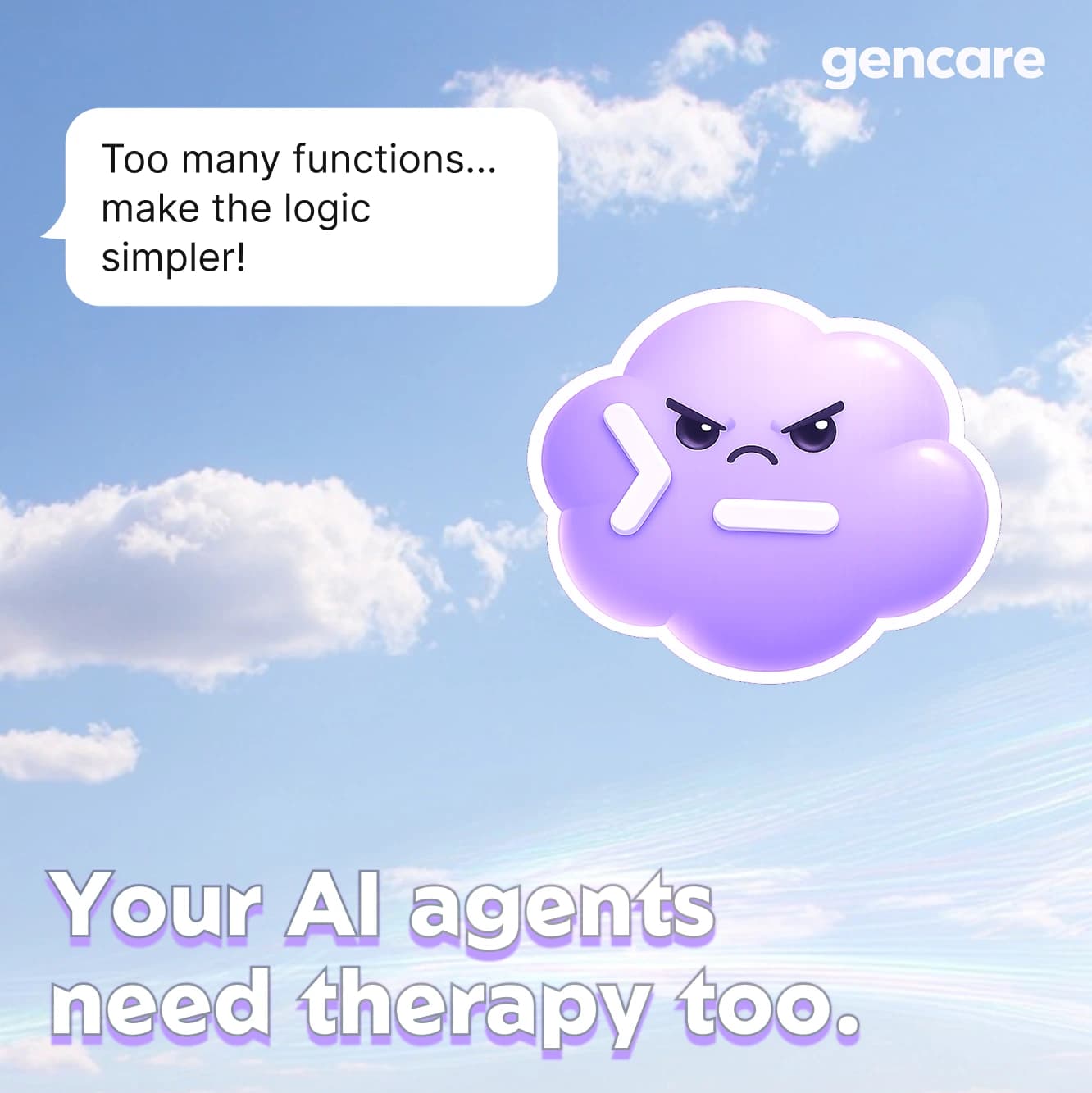
One of the strongest elements in the Gencare brand is the recurring therapist character, which becomes the symbolic face of the platform. Rather than using a generic AI robot or abstract assistant, the identity introduces a calm, slightly eccentric figure who makes the idea of “agent care” feel immediate and understandable. The character gives the brand an emotional center and helps anchor the therapy metaphor in something visual and memorable.


This idea becomes even stronger when other AI agents appear as patients within the same visual world. Familiar code and assistant characters are reinterpreted through Gencare’s soft, playful language, showing how the product works in practice: not as abstract system monitoring, but as a relationship between an AI therapist and the AI patients it supports.


As a marketing strategy, the concept is translated into a series of scenarios that place AI systems directly into therapy contexts. Instead of presenting them as tools, these systems are portrayed as patients - overwhelmed, frustrated, misaligned, or stuck. Framing their behavior in human terms makes the product instantly understandable.
As part of the growth marketing strategy, we extended the Gencare world into the real one by creating branded psychologist notebooks and delivering them to more than 5,000 psychologists across the United States, specifically those working with people in tech or who are tech-literate themselves.
The idea was simple, slightly funny, and highly shareable: if Gencare is “therapy for AI agents,” then real therapists should be the first to receive the brand artifact. Alongside the direct distribution, we created a landing page where psychologists from around the world could request a notebook for free, while anyone could send one as a gift to their own psychologist. This turned the brand idea into a playful real-world gesture - part product storytelling, part inside joke, and part viral campaign.

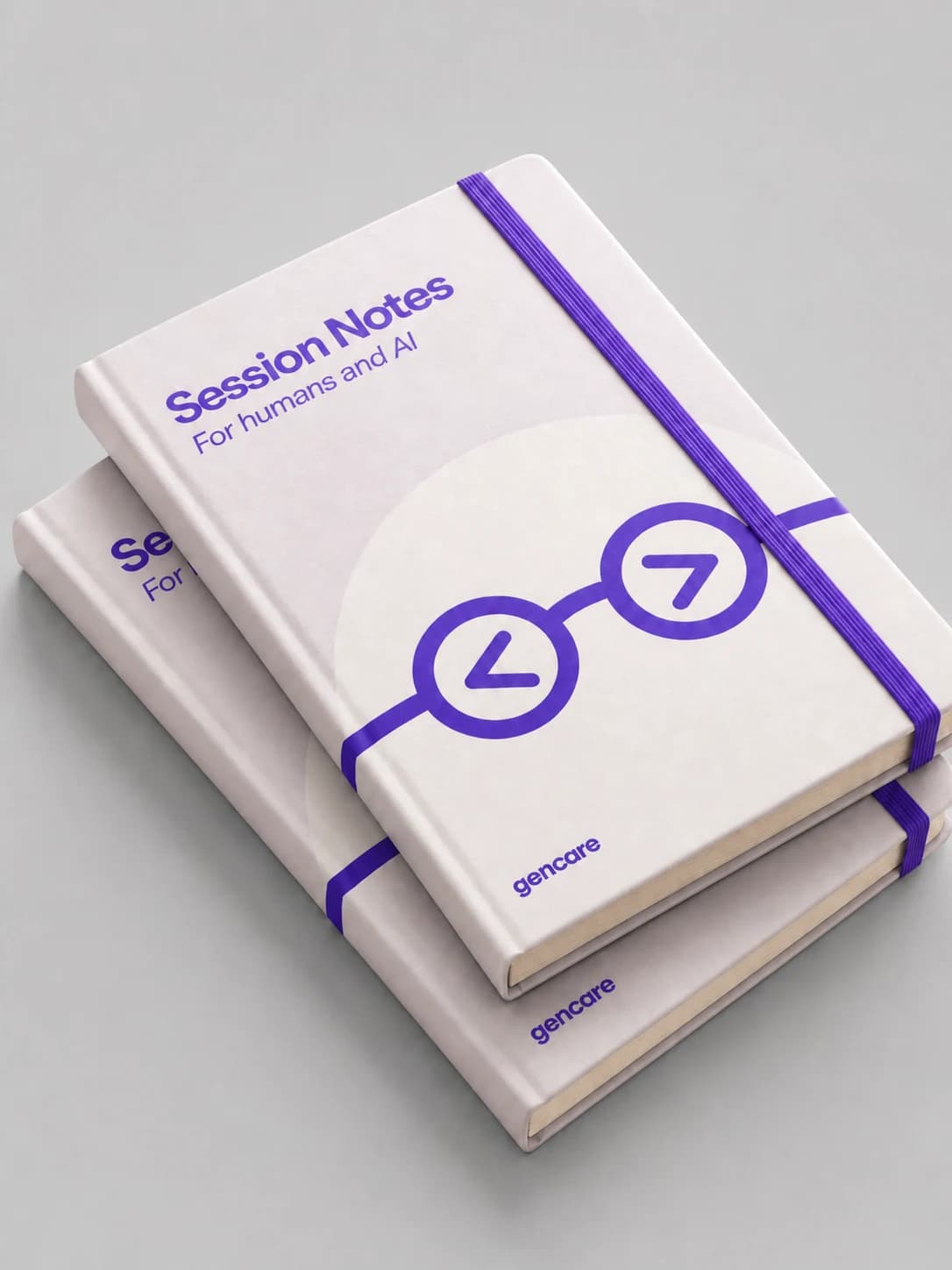
Beyond the viral effect, the notebooks also acted as subtle media placement inside therapy rooms. As psychologists wrote notes during sessions, the branded notebook stayed visible in front of clients, creating quiet curiosity without interrupting the experience. It became a useful, memorable object that kept Gencare present in a highly relevant context.

Product Design
Gencare was designed as an operational intelligence layer for the cognitive health of AI agents. Instead of focusing only on uptime, latency, or output quality, the product is built to help users understand how their agents behave over time. It surfaces recurring forms of instability - such as contradiction sensitivity, prompt overload, context fragmentation, or shifts between overly terse and overly nuanced responses - and turns them into patterns that can be monitored, interpreted, and improved.
The design approach is centered on making abstract behavioral issues feel operational. Rather than presenting agent instability as something vague or anecdotal, the product translates it into a system teams can read, track, and act on.
At a broad level, the experience moves through three complementary perspectives.
The first is a fleet-wide operational view, which helps quickly understand overall system condition. This layer emphasizes clarity and prioritization: surfacing overall health, highlighting agents that require attention, and revealing trends or concentrations of risk. The goal is to give an immediate sense of where instability is emerging and how the fleet is evolving over time.
The second perspective shifts from system-level monitoring into a more focused understanding of individual agent behavior. Here, the product is designed to make each agent feel legible: not just as a technical entity, but as a behavioral system with recurring tendencies, recent history, active risk factors, and responses to intervention. This part of the experience supports deeper investigation, helping move from identifying an issue to understanding its underlying pattern and deciding what to do next.
The third perspective expands outward again, this time showing the agent fleet as an interconnected ecosystem rather than a collection of isolated units. This view was designed to reveal relationships across roles, domains, and behavioral clusters, making it easier to spot shared patterns, systemic influence, and areas where instability may spread or concentrate. It adds a spatial and relational dimension to the product, helping to think not only about individual agents, but about the behavior of the broader network.
These three perspectives create a product that feels less like a traditional monitoring dashboard and more like a behavioral intelligence system for AI operations - one that helps teams observe, interpret, and improve agent behavior at both the individual and fleet level.
Design System
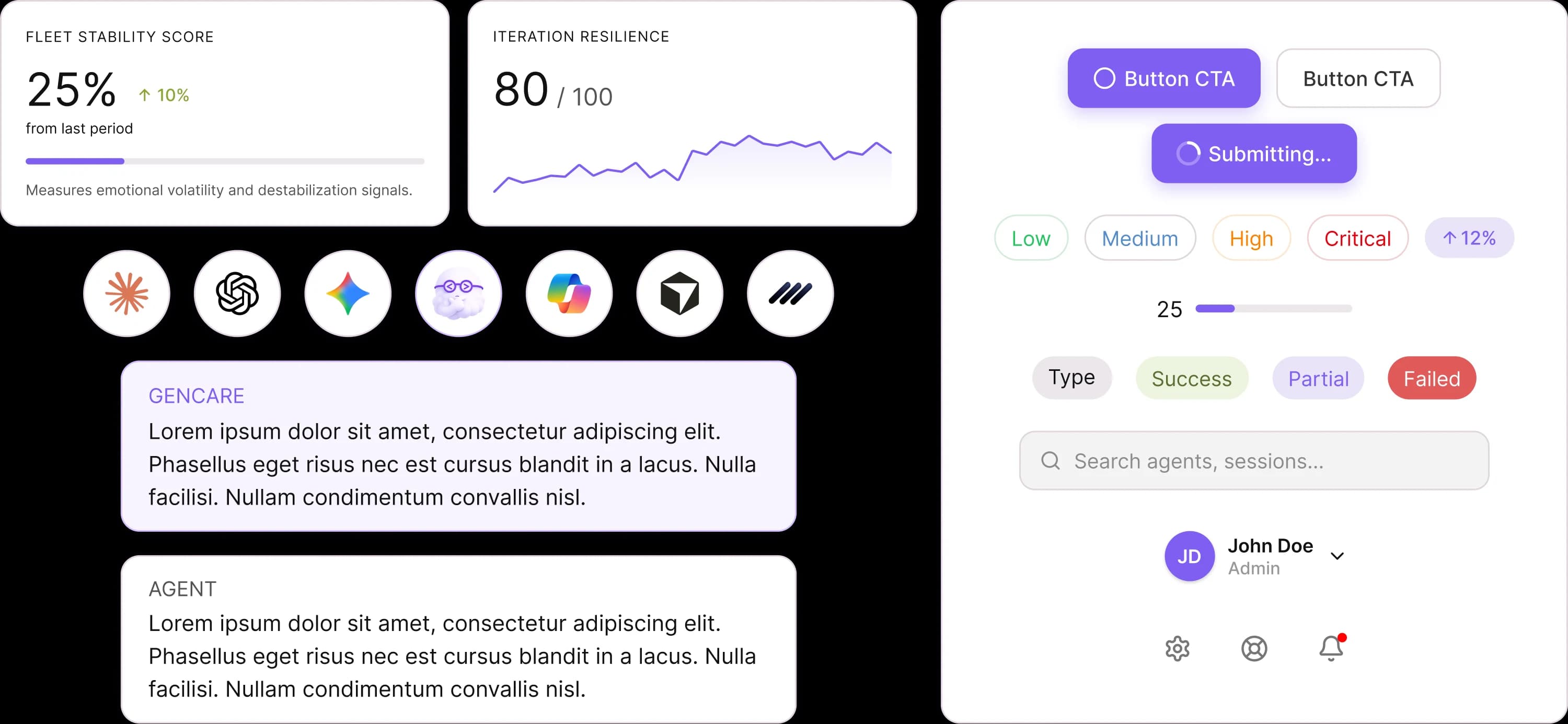
The design system was built to support a complex product without making it feel dense or intimidating. Its visual language is intentionally restrained: card-based layouts, soft gray surfaces, thin outlines, and strong typography create a calm, structured environment where teams can understand unstable behaviors clearly instead of experiencing them as noise.
The result balances analysis with approachability, giving the product clarity, warmth, and focus.
Conclusion
Gencare is built on a simple premise: AI agents are becoming more capable, and the primary challenges teams face are no longer just technical failures, but behavioral instability. Addressing this requires a new product category focused on observing, diagnosing, and improving agent behavior at scale.
Gencare introduces that category through both its brand and product. The brand establishes a clear and memorable framework, borrowing from the language of care and diagnostics to make complex behavioral issues legible and actionable. The product operationalizes this framework, providing structured tools to monitor agent health, surface behavioral patterns, track interventions, document insights, and analyze how behavior evolves across systems.
What sets Gencare apart is its focus on precision and system-level visibility. It reframes agent behavior as something measurable and manageable, giving teams a disciplined approach to maintaining reliability, consistency, and performance across a growing fleet of AI agents.